
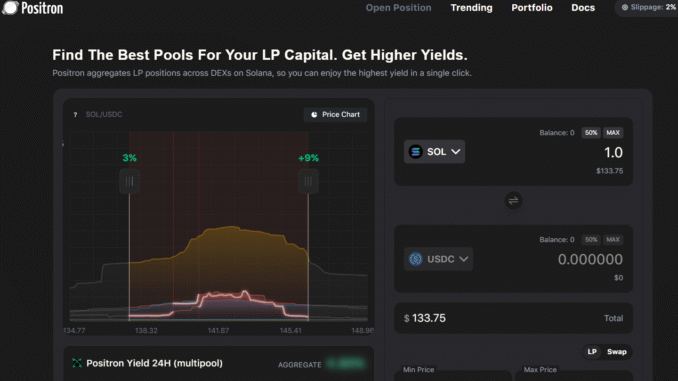

Positron is a non-custodial liquidity-routing protocol for Solana that deploys your capital across multiple pools in one click. It selects the highest-quality liquidity bands for your range and budget, turning fragmented LPing across venues into a streamlined, data-driven experience. In this article, we will explore the Positron Review.
What Is Positron?
Positron is a non-custodial liquidity-router for Solana that allows LPs to allocate liquidity across multiple pools with a single transaction. The protocol:
selects optimal liquidity bands based on market conditions
deploys capital across several pools

maintains user custody of assets at all times
charges zero swap fees and only a 1% creation fee
supports Orca, Raydium, and Meteora, with more venues in the pipeline
When you create a position through Positron, the system opens multiple subpositions on underlying venues. Some of these may drift out of range over time—this is normal. What matters is that your aggregate Positron position remains optimized, leveraging system-wide liquidity instead of a single isolated pool.

Fragmentation: The Core Problem Positron Is Designed to Solve
Liquidity on Solana is highly fragmented. Each venue has different:

The result: no single pool is consistently optimal.
A visualization of overlapping SOL-USDC liquidity across the three major venues clearly shows this fragmentation—each pool peaks at different prices, creating blind spots for LPs who choose only one pool. Without aggregation, LPs are forced to:
guess which pool might perform best
monitor multiple dashboards
frequently rebalance manually
chase APRs that quickly become outdated
Positron abstracts all of this complexity, turning the fragmented market into a unified optimization layer.
Positron’s Multi-Position Model
Positron deploys liquidity across multiple individual positions (“bands”) on different DEXs. This model is powerful for several reasons:
1. Diversified Fee Exposure
Instead of relying on fixed fee generation in one venue, your capital collects fees from the most productive zones across the ecosystem.
2. Natural Risk Distribution
Even if one pool becomes inactive or liquidity-heavy (reducing your share), other pools continue producing yield.
3. Unified UX With Distributed Strategy
You see one Positron position, but behind the scenes the system manages dozens of subpositions for you.
This model mirrors how professional liquidity managers operate—split across many venues, tuned to market behavior, and rebalanced strategically.

How the Optimization Works: The Quality Function (Q)
Positron’s optimization engine identifies the best bands using a quality function (Q).Q incorporates:
current liquidity depth
trading volume per venue
fee generation potential
historical performance
impermanent loss characteristics
user-defined price range
total liquidity budget
per-tick efficiency
Q essentially measures how much “work” each unit of liquidity will perform at a given tick and venue. Positron then selects bands that maximize total Q while respecting:
minimum band widths
execution cost limits
slippage thresholds
venue-specific rules
It is not just selecting high APR pools—it is building a mathematically optimized distribution of liquidity.
APR Calculation: A Transparent, Data-Driven Approach
Positron does not fabricate APR numbers. Instead, it computes APRs based on real fee data and realistic liquidity share estimates.
The APR computation pipeline includes:
Splitting your capital across selected bands
Converting each band allocation into the DEX’s actual liquidity structure
Fetching 24h venue-specific fee data
Analyzing tick density across the user’s selected range
Distributing fee mass conservatively across ticks
Estimating your liquidity share per tick
Capping liquidity share to avoid unrealistic dominance
Aggregating fee estimates into daily and annualized returns
The result is a grounded, defensible APR projection—not a marketing number.
Future APR Improvements
Positron plans to replace uniform fee distribution with a Brownian motion–based fee density model, meaning ticks closer to top-of-book will be weighted more accurately. This will significantly improve precision for volatile pairs and wide ranges.
Non-Custodial by Design
Positron never takes custody of user assets.You approve every transaction, maintain your keys, and your liquidity lives directly within audited DEX contracts.
Positron generates transactions; it does not custody funds.
This design choice ensures:
full user control
transparency
minimized platform risk
compatibility with secure wallet setups

User Experience, Troubleshooting, and Support
To maintain reliable execution, Positron users should be aware of common issues:
Jito tip too low → increase your tip to ensure bundle acceptance
Slippage too low → volatile pairs may require higher slippage tolerance
Balance too low → LPing requires rent for Solana accounts
For issues, users can reach out via:
Twitter: @ademplabbers, @sitrongod
Telegram: @ademplabbers, @sitrongod
Email: [email protected]
The team is intentionally accessible—no bots, no token-driven hype, just real builders.

Supported Venues and Future Roadmap
Positron currently supports:
Upcoming plans include:
expanding to additional pools and DEX architectures
enabling optional user-triggered rebalancing (“crank button”)
incorporating richer market signals into Q
exploring adaptive fee modeling
These upgrades will further enhance Positron’s role as Solana’s liquidity optimization layer.
Positron Review: Conclusion
The Solana liquidity landscape has become too complex for manual, single-pool LPing to remain competitive. As liquidity fragments across venues and new AMM mechanics emerge, LPs need a system that can intelligently navigate this environment at scale.
Positron delivers that system.By unifying liquidity provisioning across multiple DEXs, optimizing band placement, and grounding its APR calculations in transparent data, Positron offers LPs higher efficiency, better risk distribution, stronger yield reliability, full self-custody and simple UX with sophisticated underlying strategy. If spot traders use aggregators for best execution, LPs deserve an aggregator for best yield.Positron is that aggregator.
Does Positron have its own token?
Crucially, Positron does not have a token. Everything is built for LP efficiency—not speculation, not emissions farming, and not governance theater.
Are there minimum liquidity requirements to use Positron?
Minimums vary based on the number of subpositions required and Solana rent costs for opening accounts. Very small deposits may fail if account creation costs exceed capital.
Does Positron support concentrated liquidity (CLMM) pools?
Yes. It actively chooses liquidity bands across CLMM venues like Orca, Raydium, and Meteora.



Be the first to comment